
-
Use Cases
-
Resources
-
Pricing
Jan 1, 1863
President Abraham Lincoln issues the Emancipation Proclamation, declaring all slaves in Confederate territory to be forever free, marking a crucial step towards the abolition of slavery.
Image source: Emancipation Proclamation

1865 - 1877
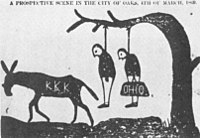
Scalawags (Southern whites supporting Reconstruction) and Carpetbaggers (Northern opportunists in the South) play significant roles in shaping the political landscape and social dynamics of the Reconstruction era.
Image source: Scalawag
Mar 3, 1865
The Freedmen's Bureau is established by Congress to provide assistance, education, and support to newly freed African Americans and war refugees, playing a vital role in the early stages of Reconstruction.
Image source: Freedmen's Bureau

Apr 14, 1865
President Abraham Lincoln is assassinated by John Wilkes Booth at Ford's Theatre in Washington, D.C., leading to the ascension of Vice President Andrew Johnson and shaping the course of Reconstruction.
Image source: Assassination of Abraham Lincoln

Nov 7, 1876
Rutherford B. Hayes, a Republican, is elected as the 19th President of the United States, marking the end of Reconstruction and the beginning of the Gilded Age.
Image source: 1876 United States presidential election

Mar 2, 1877
The Compromise of 1877 is reached, effectively ending Reconstruction and removing federal troops from the South, leading to the withdrawal of federal support for African American civil rights.
Image source: Compromise of 1877

1865 - 1866
Southern states enact Black Codes, restrictive laws aimed at limiting the rights and freedoms of African Americans, undermining the goals of Reconstruction.
Image source: Black Codes (United States)

1865 - 1870
The Thirteenth, Fourteenth, and Fifteenth Amendments are collectively known as the Reconstruction Amendments, representing a significant expansion of civil rights and equality in the United States.
Image source: Reconstruction Amendments

Dec 24, 1865
The Ku Klux Klan is founded in Pulaski, Tennessee, as a white supremacist organization aimed at terrorizing and suppressing African Americans during Reconstruction.
Image source: Ku Klux Klan

Apr 9, 1866
Congress passes the Civil Rights Act of 1866, granting citizenship and equal rights to all individuals born in the United States, regardless of race or color.
Image source: Civil Rights Act of 1866

This America's Reconstruction timeline was generated with the help of AI using information found on the internet.
We strive to make these timelines as accurate as possible, but occasionally inaccurates slip in. If you notice anything amiss, let us know at [email protected] and we'll correct it for future visitors.
Preceden lets you create stunning timelines using AI or manually.
